Arrival in Garmisch-Partenkirchen
On Sunday evening, the Erasmus+ project group of the mobility project „Climate Change in Mountain Areas“ of the Jakob-Fugger-Gymnasium embarked on their journey to Garmisch-Partenkirchen. Due to significant train delays, the group arrived at the youth hostel four hours later than planned. With the kitchen already closed, the booked dinner was replaced by packed lunches. After quickly assigning rooms and briefly discussing the upcoming program, everyone retired for the night, exhausted but full of anticipation.
Early Start and Ascent to Schneefernerhaus
The next day began at 6 a.m. After a short stop at a local bakery to pick up breakfast for the ascent, the group headed to the cogwheel train station. The scenic train ride offered spectacular photo opportunities, leaving little time for the planned breakfast.
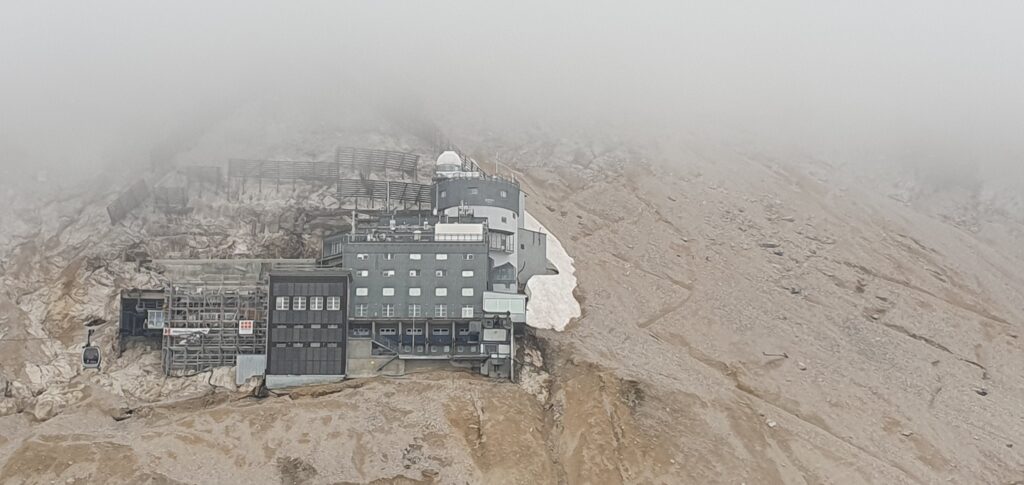
Upon arrival at Zugspitzplatt Glacier Station, the group boarded the adventurous cable car to Schneefernerhaus, whose terminal is uniquely situated within the research station itself, below the Zugspitze summit in a steep rock face. This extraordinary location set the stage for the day’s activities.


Tour of Germany’s Highest Research Station
During the nearly two-hour tour of the Environmental Research Station Schneefernerhaus (UFS), the Erasmus+ group gained in-depth insights into the work of Germany’s highest research facility. Located at 2,650 meters below the Zugspitze summit, UFS is an internationally networked center for high-altitude, climate, and environmental research. The station provides a unique platform for continuous observation of the atmosphere’s physical and chemical properties, as well as analysis of weather and climate processes—essential for understanding global climate and its future development.
The tour included visits to the measurement terrace, various laboratories where climate-relevant gases are analyzed, and the impressive permafrost tunnel. This tunnel leads into the mountain, allowing researchers to work year-round at constantly low temperatures. The group was particularly fascinated by the scientists’ work under extreme conditions, collecting data to better understand climate change and its impact on high-mountain ecosystems.
UFS is not only a research station but also a hub for international collaboration. Ten renowned research organizations have formed a „Virtual Institute“ to coordinate their scientific programs and share infrastructure. This visit highlighted the relevance to the group’s current project, „Climate Change in Mountain Areas,“ where students and teachers from five European countries collaborate.
The tour concluded with a profound appreciation for UFS’s critical role in advancing climate change understanding and developing adaptation strategies, especially in sensitive ecosystems like the Alps.
Ascent to Zugspitze Summit and Return Journey
After the informative tour, the group took the cable car back to Zugspitzplatt Station and then the chairlift up to the Zugspitze summit. Unfortunately, the weather had deteriorated, limiting visibility to just the summit cross.
Following a brief lunch break, the group began their return journey: by cable car to Eibsee Station, then by cogwheel train to Garmisch-Partenkirchen. After a two-hour rest to reflect on their new insights, the project group finally headed back to Augsburg.
Conclusion and Outlook
The visit to the Environmental Research Station Schneefernerhaus was an unforgettable experience for all participants. The insights gained into high-mountain climate research not only enriched their theoretical knowledge but also motivated further project work within Erasmus+. The group returns with new knowledge and impressions, eager to integrate these into their ongoing project activities.
Special thanks go to Prof. Dr. Rommel from bifa Umweltinstitut GmbH and the Schneefernerhaus team, especially Mr. Hiergeist, for making this extraordinary visit possible.
